
The second day of the month is my post day on Supernatural Underground and as you know, my 2026 theme is Heroines.

Due to the current noise and haste of the Life Authorial I am having a wee hiatus on the heroines until I can do them justice, which will be after Easter now.

Hermione Granger
I have still posted, but it’s a few fun photos from “Inside Middle Earth”, which I hope will be a moment of positive for readers even if the heroines must bide-a-wee (to channel my Scottish ancestors. 🙂 )
To check the photos out, click on:
A Hiatus on Heroines…Just For Now

Avatar Korra
March has been galloping by (in the best Year of the Fire Horse fashion) but there’s still time left for an SU roundup.
Starting with my 1 March post on Heroines, which regulars here will be aware featured Yeine Darr, of NK Jemisin’s The Hundred Thousand Kingdoms fame, and Rowan Birchmoon from m’own The Wall of Night series.

USA
Where Heroines is my theme for 2026, Kim Falconer is focusing on Writers as Seers — and this month’s featured author, Octavia Butler, definitely deserves that accolade, particularly for her now classic Parable of the Sower. A prophetic tale? You bet!

In the From the Backlist quadrant, the SU is refeaturing two great posts:
Modern Day Faery Tales Drawn from Fantasy and Folklore by Terri Garey

But I Don’t Wanna, said Every Hero Ever penned by Amanda Arista

Katniss Everdeen
And if you want a good companion post to Amanda’s “But I Don’t Wanna…”, I reckon two instalments of my Having Fun With Epic Fantasy Tropes series might fit the bill:
A Farm Boy/Gal Goes On A Journey — May 7, 2018

A Prince/Princess Finds A Destiny — May 14, 2018

Shuri of Wakanda
“If a scene or section gets the better of you and you still think you want it—bypass it and go on. When you have finished the whole you can come back to it and then you may find the reason it gave trouble is because it didn’t belong there.”
~ John Steinbeck, 1902 – 1968

This is only one of John Steinbeck’s ‘Six Tips for the Aspiring Writing’, but I’ve chosen to feature it alone because it relates so closely to Monday’s post on “Shooting the Rapids of ‘Why’ and ‘What.’ “
In terms of bypassing and coming back, that is also a tool I use, but it only works if you don’t need to resolve the problem at hand in order to continue at all!
As for not belonging there, sometimes it doesn’t even belong in the same book, which can be a sobering realization. 😀
In my Zoom In; Zoom Out post of March 2, I indicated there were other tools in the authorial toolkit if zooming in and zooming out both failed to resolve, or completely resolve anyway, a narrative or character issue.

We zoomed like Korra, but…
Usually, in reaching that point, it’s very likely that the original vision for the narrative, and/or a character, has been superseded by the story’s evolution so is no longer fit for purpose — which is why no amount of zooming in or out is likely to resolve matters.

Sometimes zooming ain’t enough
Whenever I arrive at that apparently insoluble juncture (hint: more often than I would like 😀 ), I find it invaluable to focus on “why?”, and then “what?”
Firstly why, when I have a good handle on both the individual trees and the whole of the forest, is the story still not working the way I envisaged? One of the main ways I shoot these particular rapids is by means of the “morning pages” (a phrase attributable to Julia Cameron), i.e the three longhand pages I write most mornings, which I find an excellent means of wrangling snarls and gnarls in the writing process.

It may be that I will then try different ‘takes’ on a scene or sequence to give effect to the wrangling. Or it may be that I have already done so in reaching this point, which is when asking “Why isn’t it working?” may not suffice. At this juncture, it’s time for the rapids of “what?” — i.e. “So if the story isn’t working out in accordance with my vision, then what is happening?”

Time to navigate wild waters
This question can be very illuminating, with a range of possible explanations. For example, it may be that an outcome similar to what I originally intended for this scene or sequence has occurred earlier in the story, even if in quite a small way, and the muse doesn’t like to take the same road twice.
Or it may be that given other changes in the story, the original plan isn’t going to work out farther down the track. The ‘snarls and gnarls’ arise when I have realized subconsciously that the story will work better if a different path is taken, but then need to give effect to that on the page.

Gnarly, huh?! AKA not every course runs smooth…
For example (hypothetically!) if two protagonists don’t fall in love as intended, after all; or the conflict between a hero and villain is worked out by some other means than fighting each other, with one or both dying. Or it may be that a duel to the death is the required solution, when the story vision was that the paths of this particular pair would never cross…
So it’s important to be prepared to try different approaches, and also to be willing to change — because no matter how genius one’s original vision, the muse is wise and almost invariably right when it comes to finding the best path through a story. 😀

But books, like rivers, do eventually end in sky. 🙂

UK/AU/NZ
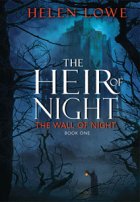
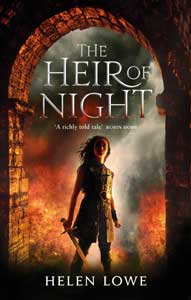
“About the Characters” features the minor characters in The Wall Of Night series, chiefly because it’s usually the major characters that get all the spotlight and discussion, but:
“I think it’s the presence of the smaller characters that (also) “makes” a story, creating texture around the main points of view.”
~ Helen Lowe (from my Legend Award Finalist’s Interview)
Initially, the series focused exclusively on characters from The Heir of Night, but now I’m continuing on with minor characters from both The Gathering Of The Lost and Daughter of Blood — in alphabetical order, by name, of course!
~*~

USA
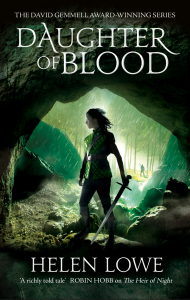
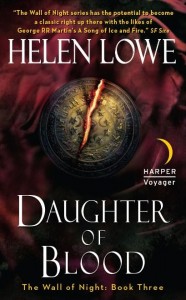
Reith: a Sea House marine, in Envoy Nimor’s escort
Murn was sitting on the ground with his head bowed, while Nimor leaned on his staff as though it was all that was holding him upright. Reith stood close beside the envoy, but his attention was on the Blood defenders. He had not stood the escort down, no doubt because he understood, as Kalan did also, that the camp’s reaction to the tempest hung in the balance.
~ from © Daughter Of Blood: The Wall of Night Book Three, Chapter 47 — Tempest
In the long slog to press ‘send’ on The Wall of Night #4 manuscript, a great deal fell by the wayside, including poetry and participating in the regular Canterbury Poets Collective (CPC) reading seasons.

Now the manuscript is with the publisher, I had been *thinking* of getting back into poetry, but the intention morphed from ‘thinking’ to ‘action’ when my friend Tim Jones indicated that he would be a guest reader at last weekend’s CPC reading. Tim has a new poetry collection out, titled Dracula In The Colonies, published by Cuba Press, and I was keen to hear him read from that, as well as putting down my ‘shilling’ (in 2026 $ terms 😉 ) for my very own copy.
So I not only caught up with Tim in advance of the reading, but felt inspired to read a (new!!!) poem myself! Titled Braided River, it speaks to both the titular braided rivers of NZ’s Canterbury province (where I dwell!) and the process of writing the fourth and final WALL series’ novel. 😀 It’s still very new, but reading a poem to an audience is always a good test of whether it has ‘legs’. (It does!)
Tim was the anchor man for the evening’s three guest poets and was very much on form — and I have already charged through the first section of Dracula in the Colonies and am enjoying it immensely. It does feel very good to be getting back into poetry again, both reading and writing it, though tis early days in the latter respect.

During the course of the day, Tim and I also caught up with another Canterbury (ex-USian) poet, Erik Kennedy , who currently has a collection, titled Sick Power Trip (Te Herenga Waka University Press) in the final round of the Ockham NZ Poetry Awards.
We went on to attend a welcome for Booker Prize winning author, Shehan Karunatilaka of Sri Lanka, who is the current Writer-in-Residence at the University of Canterbury. Shehan won the Booker for The Seven Moons of Maali Almeida in 2022.

Tis unquestionably wonderful to have writers of such calibre here with us in Christchurch, and also very nice to have the opportunity to meet Shehan Karunatilaka in person — on one of those mild, sunny, autumnal afternoons that Canterbury knows how to put on at this time of year.
In preparing Monday’s post, which refeatured an earlier SF Signal post on Elfrid, the heroine of Ru Emerson’s debut novel, The Princess of Flames (1986), I discovered that the author passed away in August of last year.

As you’ve doubtless already figured out, I’m a fan of The Princess of Flames, but I also enjoyed her Tales of Nedao trilogy:
To the Haunted Mountains (1987)
In the Caves of Exile (1988) and
On the Seas of Destiny (1989)

Ru Emerson also wrote another standalone novel, The Sword and The Lion (1993), under the pen name Roberta Cray, which still has a place of honour on my bookshelves.
These do not comprise all her works, but are the ones by which I knew her, and considered her a Fantasy “name.” Her stories enriched my reading life and her passing leaves a notable gap in the Fantasy pantheon.

Last month, in Post #1 of my Heroines series on Supernatural Underground, one of the featured heroines was Elfrid, from Ru Emerson’s debut novel, A Princess of Flames.
I took a more indepth look at Elfrid about a decade ago now, in a series on (the late, great) SF Signal, titled “Fantasy Heroines That Rock My World.” One in which I shone a spotlight on my favourite Fantasy heroines, not only revealing who each one is, but why I believe they kick butt and take names as characters.
Here’s what I had to say about Elfrid then:
“A long time standout in my cast of favorites is Elfrid, the “Princess of Flames”, from Ru Emerson’s book of the same name. At face value, Elfrid’s arc might seem to be somewhat stereotypical for a Fantasy heroine. She is the “misfit”, illegitimate daughter in a family of legitimate half-siblings, and is also adept with weapons in a society that disapproves of women warriors. Exiled with her deposed father (nods to Cordelia and King Lear), Elfrid returns eight years later, impersonating a famous, fighting Archbishop (Gespry of Rhames) to wreak revenge on her half-siblings and endeavor to save the kingdom from their tyranny.

Yet although that is the basic plot, Elfrid is not in the least bit stereotypical. Here’s why: firstly, she’s not only good with weapons, she is an effective warrior – but in a matter-of-fact way that I really like. When the chips are down, she both knows what to do, and proceeds to take care of business. This includes both in battle, where she has to emulate Gespry’s fame as a general, but also in duels:
“Hyrcan’s sword pressed down, slipped harmlessly away as [Elfrid] executed a swift, circular movement of the wrist. Three clashing blows rang out.”
It would still be easy to write a cardboard cut-out woman–warrior, though, but Elfrid works because she is very much a real person. The fabric of her relationships—with her exiled father, the loyal companions surrounding the ostensible Gespry, and both old friends and enemies when she returns home—is very much the heart of the book. Elfrid is convincing, too, because of her combination of determination and uncertainty as she walks the knife edge of deception, for high stakes.
“There were long. awkward silences between the King’ words, silences into which anything might be read, and her own inner sense caught radiating suspicion, fear, uncertainty. Alayya, Elora, if he has suspected, if he suspects – ”

I also like that Elfrid is unarguably equal in all her relationships, including with the man she loves. When they first re-meet after eight years, she is prepared to kill him to maintain her imposture and protect her companions, at least until she can be persuaded of his good faith. But after he has sworn to her, she is also clear that:
“…we ride … as equals, you and I, or not at all.”
Loyal to those she loves and respects, strong of arm and of will, but also fairminded, both a warrior and a leader – it’s hardly surprising that Ru Emerson’s Elfrid continues to rock my world.”
Hello March! And to post two in my Heroines series on the Supernatural Underground.

This month’s dynamic duo are Yeine Darr from NK Jemisin’s The Hundred Thousand Kingdoms and Rowan Birchmoon from m’own The Wall Of Night series.

At face value, these may seem like two wildly disparate characters — but I have found some common ground. To check out more, follow the link:
A Year of Heroines #2 — Yeine Darr and Rowan Birchmoon
And enjoy!

USA

UK/AU/NZ